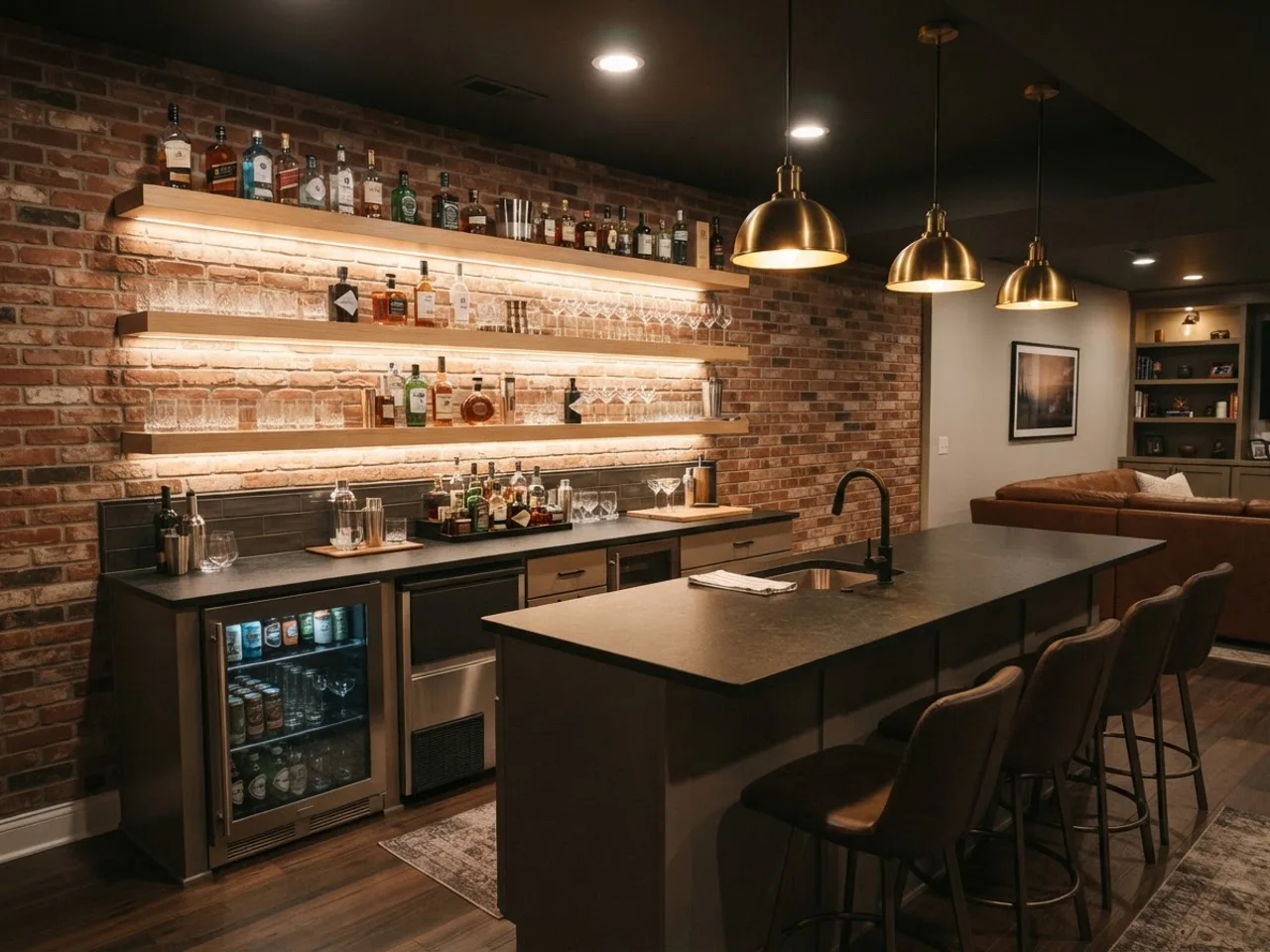
Wet bar or dry bar: which one belongs in a basement?
A dry bar has no sink. It is a counter, storage, a fridge and shelves, and it covers 90% of what a basement bar does: bottles, glasses, a place to lean. A wet bar adds a sink, which means supply lines, a drain with slope or a pump, a vent and a plumbing permit. That one fixture moves the price by thousands, so decide it first and design around the answer.
The honest test: measure from the bar wall to the nearest drain stack. Under 10 ft with the stack downhill, the wet bar costs $1,500 to $4,000 more than dry and is worth it if you host often. Past 20 ft, or with the bar below the sewer line (most basements), you are adding a pump, and the sink starts to cost more than the fridge, the top and the stools combined.
The compromise that works: a dry bar with a countertop nugget ice maker and a 24 in beverage fridge, and the sink stays in the kitchen. Nobody at the party knows, and the $5,000 goes into the back wall, where people can see it.
| Dry bar | Wet bar | |
|---|---|---|
| Sink | None; a countertop ice maker and a bucket cover ice | 15 in bar sink, faucet, drain and vent |
| Permits | Electrical only, if you add circuits | Plumbing and electrical |
| Where it fits | Any wall with an outlet | Within reach of a drain stack, or with a pump |
| Cost premium | Baseline | +$1,500 to $4,000 near a stack; +$3,000 to $7,000 with a pump |
| What you give up | Rinsing glasses downstairs | Money and a week of trades |
| Build it when | Nine basements out of ten | You host weekly or the kitchen is two floors up |
Can a bar fit in a small basement?
Yes, and the 6 ft bar is often the better-looking one. A 6 ft counter seats two stools at 26 in with room for a tray at the end, or three at 24 in if the guests are family. Keep it dry, use 12 in deep floating shelves instead of a back bar, and put the fridge under the counter so the whole thing is one wall, 30 in deep including the overhang.
Small bars that work: a 6 ft run under the stairs (the low headroom is fine for a 42 in counter, and it turns dead space into the best corner in the room); a bar-cart alcove framed in slat wood with a single shelf and a strip light; a 4 ft beverage station at kitchen height next to the theater, no stools, just the fridge and the glasses. What does not work: a full-height bar wall in a room under 12 ft wide. It cuts the room in two and the sofa ends up in the stool zone.
- 6 ft straight dry bar: 2 to 3 stools, undercounter fridge, three floating shelves. Footprint 6 × 7 ft with stools. $1,500 to $4,000 installed.
- Under-stairs bar: 5 to 7 ft of counter following the stringer, shelves stepped with the ceiling, LED strip under each. $2,000 to $5,000.
- Beverage station: 4 ft of kitchen-height counter, fridge, one open shelf, no stools. $1,200 to $3,000.
- Peninsula bar: a 6 ft counter perpendicular to the wall, stools on the room side, so it doubles as the theater's back rail. $2,500 to $6,000.
What should the back wall be made of?
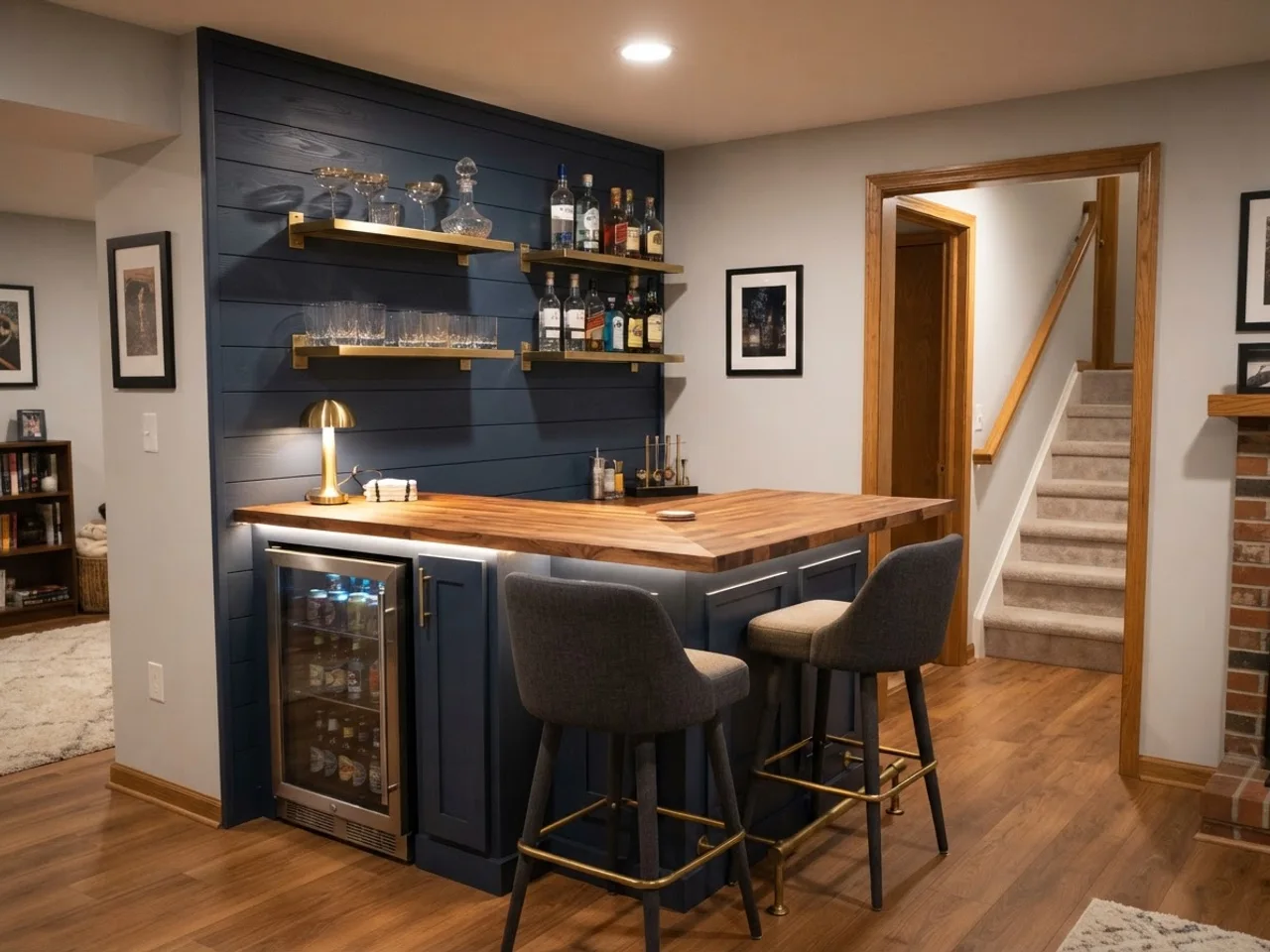
The back wall is the show. Guests look at it all night, it fills every photo, and it is where the finish budget belongs: the counter is a slab, the back wall is the design. Pick one material, run it full height from counter to ceiling, and let the shelves and the light do the rest. Two materials on one wall is how a bar starts to look like a kitchen.
Shelves: floating, 12 in deep, three tiers, the lowest 18 in above the counter or the fridge. Glass with an LED channel underneath is the classic; white oak or walnut with a strip on the underside is warmer and hides fingerprints. Skip closed upper cabinets. A bar is supposed to show the bottles.
Prices below are per square foot installed for a typical 40 to 60 sq ft back wall (10 ft wide, counter to ceiling). Multiply by 50 and you have the line item.
| Material | Look | 2026 cost per sq ft, installed | Notes |
|---|---|---|---|
| Thin brick veneer | Industrial, pub | $15 – $30 | Real clay, 1/2 in thick; seal it or it sheds dust on the glasses |
| Slat wood (fluted panels) | Mid-century, modern | $18 – $40 | Prefinished oak or walnut panels; hides the LED wiring in the gaps |
| Stacked stone veneer | Rustic, luxury | $25 – $50 | Heavy; needs backer board and a calm room around it |
| Large-format porcelain tile | Modern, clean | $12 – $35 | Wipes clean; 24 × 48 in slabs read as stone for a third of the price |
| Painted shiplap | Farmhouse, cozy | $8 – $18 | Cheapest full-height finish; navy or forest green with brass shelves |
| Mirror with glass shelves | Classic bar, luxury | $20 – $45 | Doubles the bottle count and the light; fingerprints are the tax |
| Antique mirror or smoked glass | Hotel bar | $40 – $80 | The most expensive square footage in the basement and the most copied |
How do you arrange seating and lighting around a basement bar?
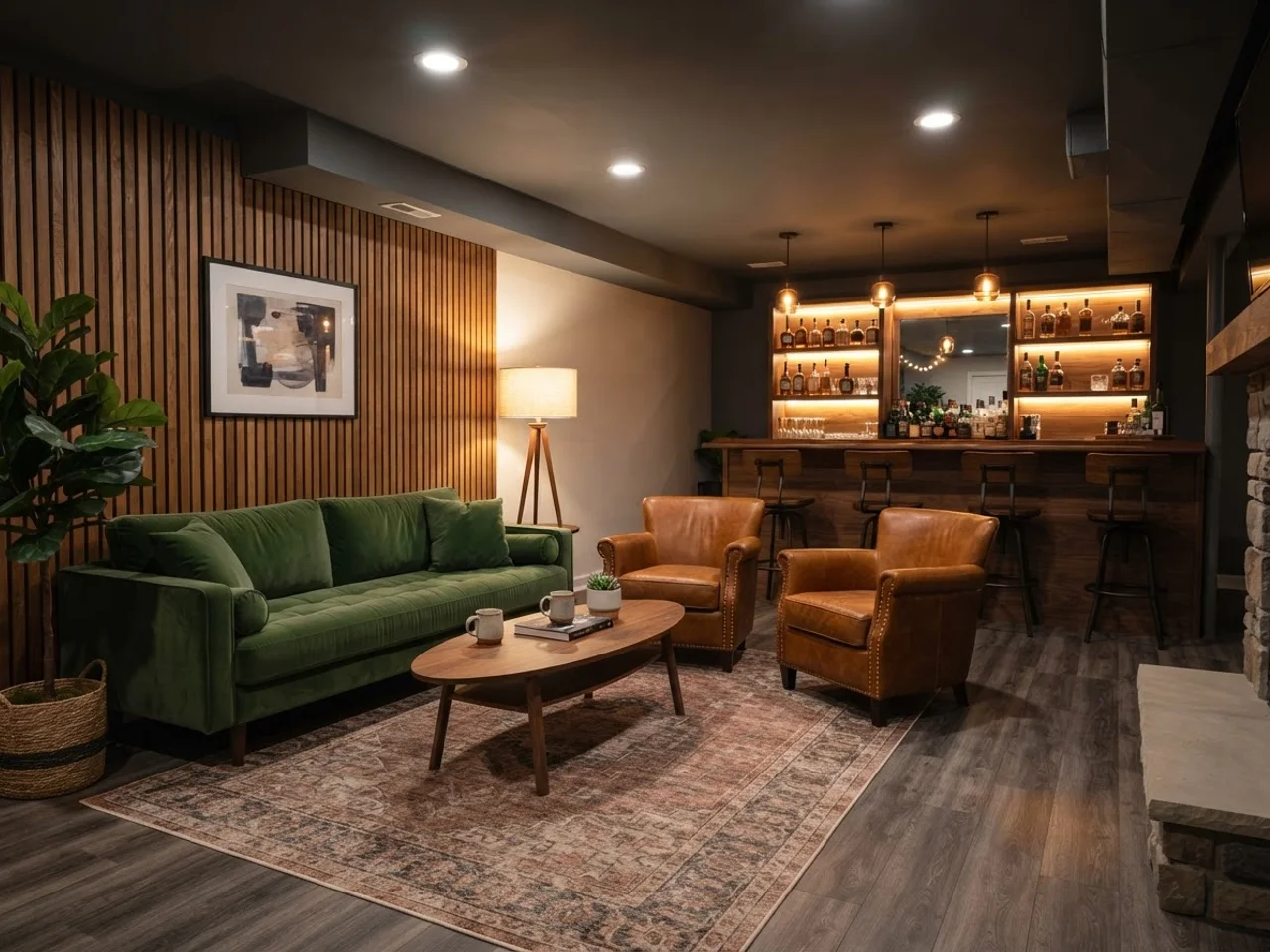
Three or four stools plus a lounge corner outdraws a long, empty counter. People sit where it is soft, so the bar is the pouring station and the seating is where the night happens: a sofa or two armchairs within 8 to 10 ft of the counter, facing it, or angled toward the screen if the bar shares the room with a theater. A bar with eight stools and no sofa is a place people stand next to.
Stools: 30 in seat height for a 42 in counter, 24 to 26 in apart, and backs if anyone will sit for more than one drink. Swivels with footrests get used; backless saddle stools look good in the photo and empty in real life. Leave 42 in behind the stools so someone can pass with a plate.
Lighting is three layers or it is wrong. Pendants over the counter (bottoms 30 to 36 in above the top, three over 8 ft, four over 10 ft) at 2700 K so faces look good; an LED strip under each shelf and one under the counter overhang, on a dimmer; and the room's general light on a separate switch so the bar can glow while the rest of the basement goes dark for the movie. Skip colored RGB unless the room is a game room; warm white on a dimmer is what every hotel bar uses for a reason.
- Seating mix for a 10 ft bar: 4 stools, a 3-seat sofa, 2 armchairs, one drink table per seat.
- Seating mix for a 6 ft bar: 2 stools and a loveseat; the bar is the backdrop, the sofa is the room.
- Pendants: 2700 K, dimmable, 250 to 400 lumens each, bottoms 30 to 36 in above the counter. Under a 7 ft ceiling, recessed cans instead.
- Shelf and toe-kick LEDs: 2700 to 3000 K, in an aluminum channel with a diffuser so you see glow, not dots.
- A strip under the counter overhang on the guest side lights knees and makes the bar float. Cheapest trick on this page, $40 in parts.
What refrigeration and ice does a basement bar need?
An undercounter beverage fridge plus a small ice maker beats a full-size refrigerator on looks, power draw and noise. The 24 in beverage center holds 100 to 150 cans, or 40 bottles of wine on the dual-zone models, sits flush under a 36 in back bar, and shares a 20 A circuit with the ice maker. A full-size fridge in a bar is a garage.
Ice: a 15 in undercounter ice maker makes 25 to 50 lb a day, needs a 1/4 in water line and a drain (gravity or a small built-in pump), and it is the one appliance that makes a bar feel like a bar. On a dry bar, a countertop nugget maker ($150 to $500, fill it by hand, no plumbing) does the same job for a household. Kegerators are a commitment: $600 to $2,500, a CO2 tank, and a keg goes flat in 6 to 8 weeks if you are not drinking it.
| Appliance | Size | 2026 price | Needs |
|---|---|---|---|
| Beverage center | 24 in wide, 34 in tall, undercounter | $500 – $1,500 | Outlet; front venting if built in |
| Dual-zone wine and beverage | 24 in, undercounter | $900 – $2,500 | Outlet; 1 in air gap on the sides if not front-vented |
| Undercounter ice maker | 15 in, 25 to 50 lb a day | $1,500 – $3,000 | 1/4 in water line, drain or pump, outlet |
| Countertop nugget ice maker | Sits on the counter | $150 – $500 | Outlet; fill by hand, no plumbing |
| Kegerator, single tap | 24 in, undercounter or freestanding | $600 – $2,500 | Outlet; CO2 tank; a keg every 6 to 8 weeks |
| Dishwasher drawer | 24 in single drawer | $900 – $1,800 | Wet bar only; hot supply and drain |
How much does a basement bar cost?
A basement bar in 2026 runs from about $2,000 for a framed dry bar with a stock top to $40,000 for a custom wet bar with stone, a full back bar and a lounge. The typical contractor-built bar lands at $8,000 to $15,000: a handsome dry bar with stock cabinets and a quartz top, or a simple wet bar next to an existing drain. Most of the spread is three decisions: sink or no sink, stone or wood on the top, and how much of the back wall is a finish material instead of paint.
Line items below are installed, mid-range, US averages. DIY takes 30 to 50% off the dry bar (it is framing and trim carpentry) and less off the wet bar, because the plumbing and the electrical are the part you should not do yourself. Bars are the one basement room where the finish on 50 sq ft of wall can cost more than the flooring for the whole room, so decide the back wall before the tile store decides it for you. For the rest of the basement, the finishing-cost guide has the per-square-foot numbers.
| Line item | Dry bar | Wet bar | Full custom bar |
|---|---|---|---|
| Framing, cabinets and bar front | $800 – $2,500 (framed wall or stock cabinets) | $2,000 – $5,000 (stock base cabinets front and back) | $5,000 – $12,000 (custom cabinetry) |
| Counter top | $250 – $1,500 (butcher block, laminate, quartz remnant) | $1,200 – $3,000 (quartz, 10 ft plus back bar) | $2,500 – $6,000 (stone, waterfall edge) |
| Back wall finish | $300 – $1,200 (paint, shiplap or slat panels) | $800 – $2,500 (brick or tile, 50 sq ft) | $2,000 – $5,000 (stone, antique mirror, glass shelving) |
| Shelving and lighting | $300 – $900 | $600 – $1,800 | $1,500 – $4,000 |
| Plumbing | $0 | $1,500 – $4,000 (add $1,000 to $3,000 for a pump) | $3,000 – $7,000 (sink, dishwasher drawer, ice maker line) |
| Electrical | $300 – $800 (one circuit, 3 outlets) | $600 – $1,500 (two circuits, GFCI) | $1,000 – $2,500 |
| Appliances | $0 – $1,200 (beverage fridge) | $1,000 – $3,000 (fridge and ice) | $3,000 – $7,000 (fridge, ice, wine, dishwasher drawer) |
| Stools and lounge seating | $300 – $1,200 | $800 – $2,500 | $2,000 – $5,000 |
| Permits | $0 – $200 | $150 – $500 | $300 – $800 |
| Total | $2,000 – $8,000 | $8,000 – $20,000 | $20,000 – $40,000 |