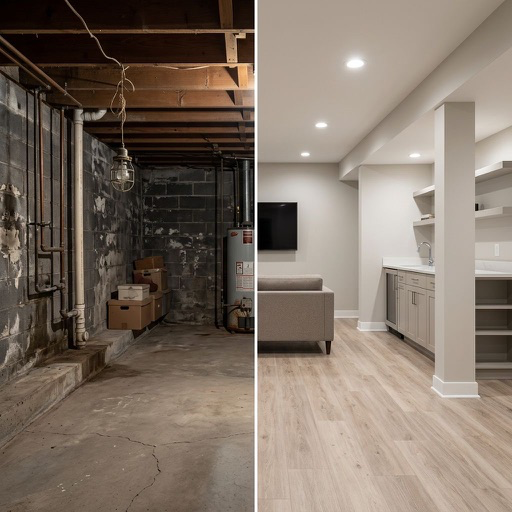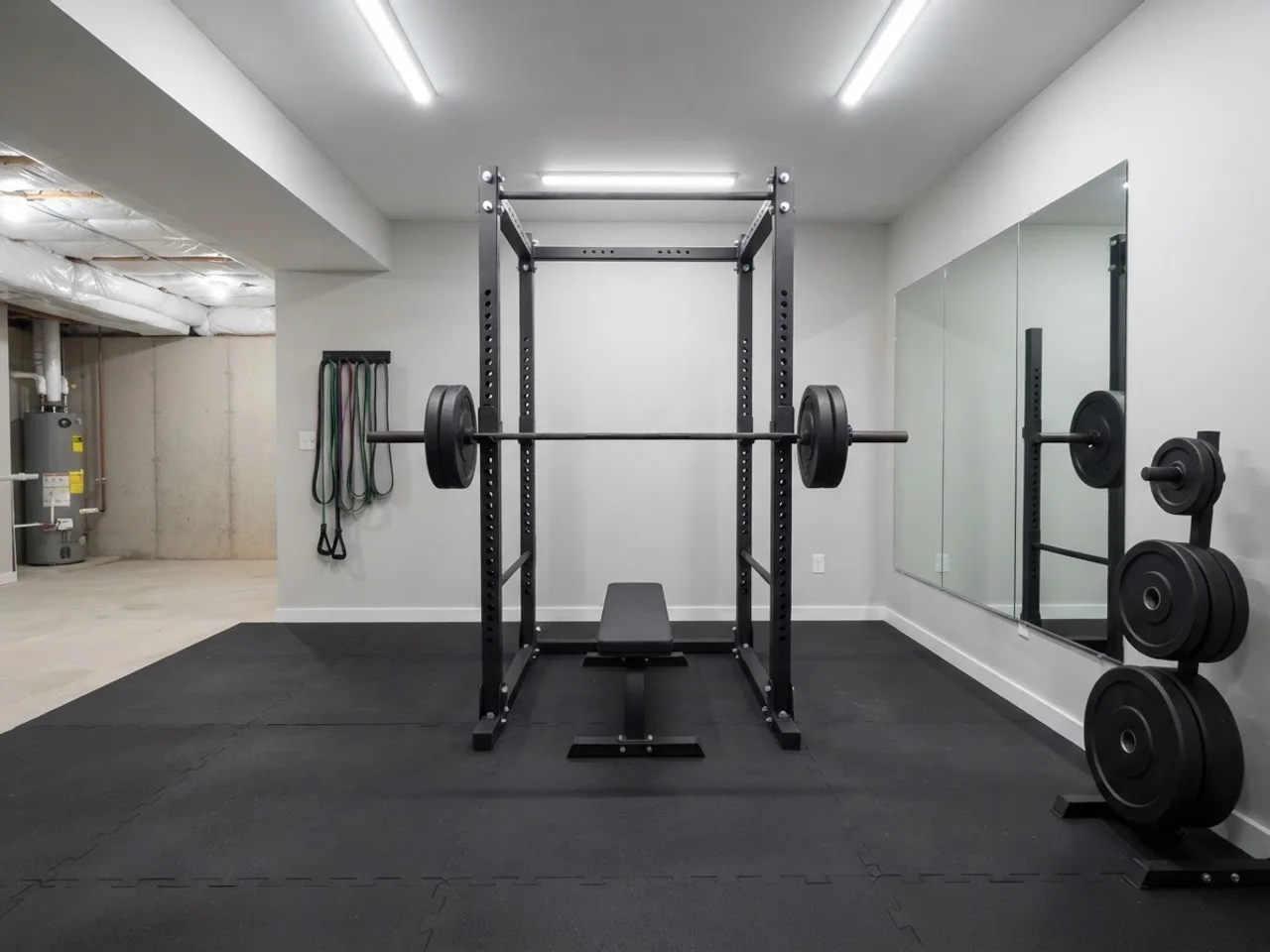
How much ceiling height does a basement gym need?
Measure from the finished floor to the lowest thing above it, not to the joists. Ducts, beams and the 3/4 inch of rubber you are about to add all count. Most basements land between 7 and 8 feet, and that one foot is the difference between a gym where you can press overhead and one where you cannot.
The rule for anything standing is your height plus reach. A 5 foot 10 inch lifter locks out an overhead press at about 7 feet 6 inches; a 6 foot 2 inch lifter needs about 7 feet 11 inches. Jump rope wants standing height plus 12 to 18 inches. Pull-ups on a rack need the bar high enough that your chin clears it with your feet off the floor, which puts a full-height rack at 8 feet of ceiling or more. Treadmills are the sneaky one: the deck sits 6 to 10 inches up and you bounce, so a 6 foot runner on a 9 inch deck wants 7 feet 6 inches.
At 7 feet, build a horizontal gym and stop fighting it: bench press, deadlift, rows, squats in a 72 inch short rack, rower, bike, and seated overhead work. Do not lower the slab to gain height; that is a $30,000 underpinning job, not a gym project.
| Activity | Ceiling needed | Note |
|---|---|---|
| Power rack with pull-up bar | 8 ft or more | Standard racks are 80 to 92 in tall; 72 in short racks fit 7 ft ceilings without pull-ups |
| Standing overhead press | Your height + 22 to 24 in | 5 ft 10 in lifter: ~7 ft 6 in; 6 ft 2 in lifter: ~7 ft 11 in |
| Jump rope | Your height + 12 to 18 in | Rope arc, not your head, is the limit |
| Box jumps, burpees | 8 ft | Add the box height to your standing reach |
| Treadmill | Your height + deck + 6 in | Deck sits 6 to 10 in up; check the lowest duct over the belt |
| Rower, bike, elliptical | 7 ft (elliptical 7 ft 6 in) | Seated; ellipticals lift you 6 to 12 in |
| Bench, deadlift, rows, kettlebell swings | 7 ft | The whole horizontal program works at code minimum |
What flooring holds up in a basement gym?
Rubber, in two thicknesses. Three-eighths inch (8 mm) rubber tiles or rolls cover the room: they handle dumbbells to about 50 pounds, cardio machines, kettlebells and the smell of a gym, at $2 to $4 per square foot. Three-quarter inch (19 mm) tiles go only where a loaded barbell lands, under the rack and on the deadlift zone, at $4 to $7 per square foot. Covering a whole room in 3/4 inch is money spent on floor you will stand on, not drop on.
Horse-stall mats are the budget version of the same thing: 4 by 6 foot, 3/4 inch, about $45 to $65 each at a farm store, which works out to $2 to $2.70 per square foot. They weigh 100 pounds apiece, do not interlock, and smell like a tire shop for a month. For a rack zone in an unfinished basement they are the right call. A strip of synthetic turf over rubber underlay ($3 to $6 per square foot) earns its space only if you can run 20 feet or more; a 12 foot turf lane is decoration.
Vinyl plank looks finished and costs $2 to $5 per square foot, and it is fine for a cardio-only room. It dents under a loaded rack and cracks under a dropped plate, so anywhere iron lands gets rubber on top of it. Whatever you pick, check the slab first: tape a square of plastic down for 48 hours, and if it fogs, put 6 mil poly under the rubber or you will find mold when you lift a mat two years from now.
| Flooring | Thickness | 2026 price / sq ft | Best for | Drawback |
|---|---|---|---|---|
| Rubber tiles or rolls | 3/8 in (8 mm) | $2 – $4 | Whole-room base, cardio, dumbbells | Not enough under dropped barbells |
| Rubber tiles | 3/4 in (19 mm) | $4 – $7 | Rack and deadlift zones | Heavy, pricey for a full room |
| Horse-stall mats | 3/4 in | $2 – $2.70 ($45–65 per 4×6 mat) | Cheapest heavy-duty zone | 100 lb each, no interlock, strong smell for weeks |
| Turf strip | 1/2 in turf + rubber underlay | $3 – $6 | Sled pushes, lunges, carries | Needs 20 ft of run to be worth it |
| Vinyl plank (LVP) | 5 to 8 mm | $2 – $5 | Cardio-only rooms, finished look | Dents under racks, cracks under drops |
How do you deal with moisture, air and rust in a basement gym?
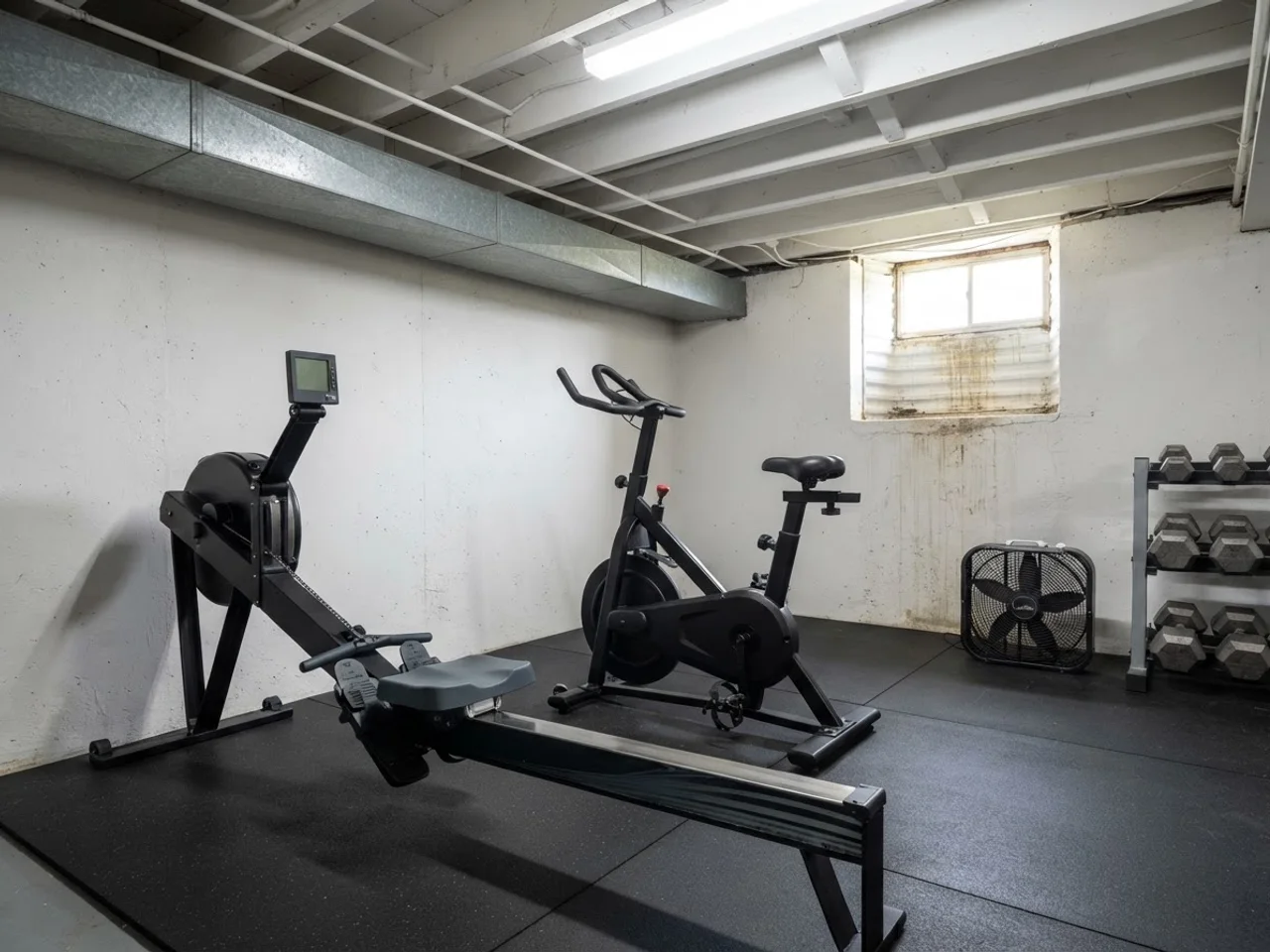
Fifty percent relative humidity is the target, and a 50 pint dehumidifier ($250 to $350) drained to a floor drain or condensate pump gets there in most basements. Above 60 percent the bar knurling goes orange, the rubber floor smells, and mold starts under the mats. Below 40 percent the room feels fine but you are paying to over-dry it. A $10 hygrometer on the wall ends the guessing.
Air movement matters more than temperature. A basement at 60 to 65 degrees is ideal for lifting; what makes it feel bad is still air and the CO2 you produce in a closed room. Two box fans or a ceiling fan handle a bare-walls gym. If the room is finished and the HVAC does not reach it, a 9,000 to 12,000 BTU mini-split ($3,000 to $5,000 installed) gives heat in January, cooling in July and a fan the rest of the year, and it is the single upgrade that makes people actually use the gym in winter.
Rust is the tax on humid basements. Wipe bars with a nylon brush and 3-in-1 oil once a month, store plates on a tree instead of the floor, and pay the $100 premium for a Cerakote or stainless bar if the space is unconditioned. Chalk left on a bar in a damp basement is a rust starter, not a finish.
- Dehumidifier set to 50 percent RH, drained, running year-round
- Fans in an unfinished gym; a mini-split once the walls go up
- Oil the bar monthly, store plates off the floor, brush off chalk
- Poly under rubber if the slab wicks moisture
What layouts fit a basement gym?
A rack needs more width than its footprint. The base is about 4 by 4 feet, but a 7 foot Olympic bar is 86 inches long and you load plates on both ends, so the rack zone is 9 to 10 feet wide by 6 feet deep. Put it where the ceiling is highest and never directly under a duct or the main beam. The 10 by 12 lifting corner (120 square feet) is exactly that: rack against the long wall, flat bench inside it, a plate tree in the corner, dumbbells on a wall rack, and nothing else. No cardio, and it does not need any.
At 12 by 20 feet (240 square feet) you get lifting plus cardio. Keep the 10 by 12 rack zone at the high end of the room, run a mirror along the 20 foot wall, and put the rower (8 by 2 feet in use, stored upright) and a bike (4 by 2 feet) at the other end under the low side of the ceiling. That leaves about 4 feet of open floor between the two for stretching and kettlebells. This is the layout most basements end up with, and it costs about $600 to $950 in 3/8 inch rubber plus $300 to $500 for the 3/4 inch zone.
The 15 by 25 full gym (375 square feet) adds a 3 foot wide turf lane along the long wall for sled pushes and lunges, an 8 by 8 deadlift platform with the rack at the back center, cardio at the far end and a 6 by 6 stretching mat by the door. Posts in the middle of the room are not the end of it: mount a mirror panel on one and a band anchor on the other. One photo of the empty room rendered as a Home Gym in the app tells you whether the rack fits between the posts before you order it.
| Layout | Size | What fits | Flooring cost (2026) |
|---|---|---|---|
| Lifting corner | 10 × 12 ft (120 sq ft) | Rack, bench, plate tree, dumbbell rack | $500 – $900 |
| Lifting + cardio | 12 × 20 ft (240 sq ft) | Rack zone, mirror wall, rower and bike, 4 ft stretching gap | $900 – $1,500 |
| Full gym with turf lane | 15 × 25 ft (375 sq ft) | 8 × 8 platform, rack, 25 ft turf lane, cardio end, 6 × 6 mat area | $1,800 – $3,000 |
What about mirrors, lighting and dropped weights?
Mirrors do two jobs: form check and making a 12 foot wide basement read as 24. Gym mirror panels are 48 by 72 inches, tempered glass or acrylic, $150 to $250 each; three of them cover a 12 foot wall. Mount them with the bottom edge 12 to 18 inches off the floor, above the mat line and out of the way of rolling plates, and put them beside the bar path rather than directly in front of it, where the reflection distracts on heavy sets.
Light is the cheapest fix for the dungeon problem. The target is 4000K color temperature at 50 or more foot-candles on the floor, which means about one 4 foot LED shop light (4,500 lumens, $30 to $40) per 40 to 50 square feet: five or six fixtures for a 12 by 20 room. Paint the walls and the ceiling a light matte gray or white; a black ceiling looks great in a theater and eats half your light in a gym. Treadmills go on a dedicated 20 amp circuit, everything else is fine on a 15.
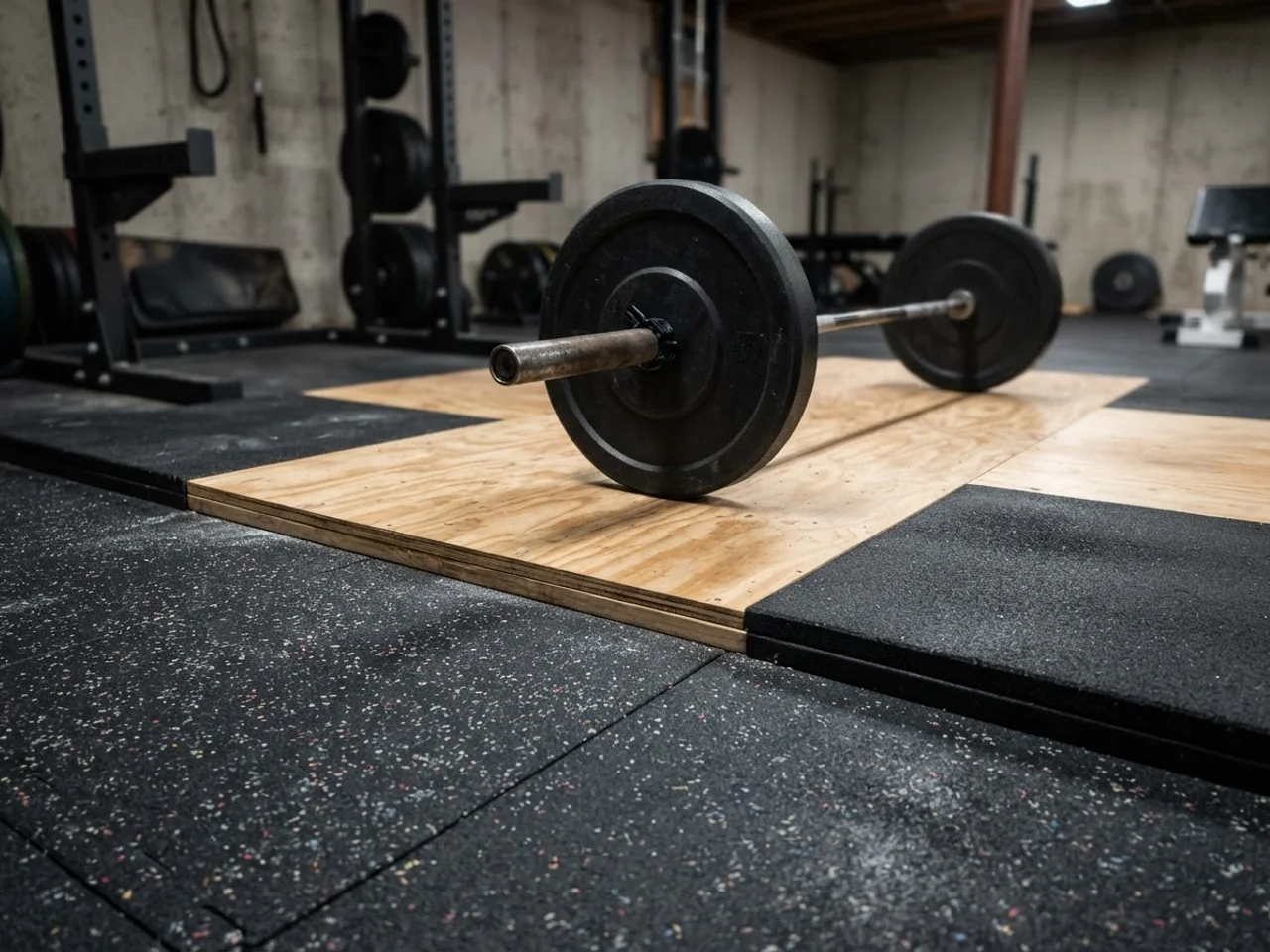
Dropped weights are a noise problem, not a structural one: the slab does not care. Bumper plates instead of iron, a pair of 2 to 4 inch drop pads ($150 to $250), and 3/4 inch rubber under the rack cover most of it. If you deadlift heavy, build an 8 by 8 platform from two layers of 3/4 inch plywood with stall mats on the sides ($250 to $400 in materials); it protects the bar and the plates and keeps the sound in one place. What travels upstairs travels through the joists, so Rockwool between them and 5/8 inch drywall on resilient channel ($3 to $5 per square foot) is the answer if a bedroom sits above the rack.
What does a basement gym cost in 2026?
There are three honest tiers and the equipment is separate from all of them. Paint and mats, $1,500 to $3,000: 3/8 inch rubber over 200 square feet ($500 to $800), masonry paint on the walls ($150), four shop lights ($150 to $200), a dehumidifier ($250), two or three mirror panels ($300 to $500) and a fan. This is a real gym and it looks intentionally industrial; the walls do not need drywall to get strong in.
A finished room, $5,000 to $12,000, adds framing, insulation and drywall on the exterior walls, a drop ceiling or painted joists, two new circuits, and 3/4 inch rubber in the rack zone. A full build, $15,000 to $25,000, adds a mini-split, a drywall ceiling with insulation for the bedroom above, a turf lane, and an egress window if the room ever needs to count as a bedroom. Starter equipment runs $2,000 to $4,000 for a rack, bar, 260 pounds of bumpers, an adjustable bench and adjustable dumbbells; a rower or bike adds $500 to $1,500 each.
| Scope | 2026 budget | What you get |
|---|---|---|
| Paint and mats | $1,500 – $3,000 | 3/8 in rubber, masonry paint, 4 shop lights, dehumidifier, mirror panels, fan |
| Finished room | $5,000 – $12,000 | Framing, insulation and drywall, ceiling, 2 circuits, 3/4 in rack zone, mirror wall |
| Full build with mini-split | $15,000 – $25,000 | Everything above plus mini-split, insulated ceiling, turf lane, platform, egress window if needed |
| Equipment (separate) | $2,000 – $4,000 starter | Rack $400–1,200, bar and bumpers $600–1,000, bench $200–400, dumbbells $300–500; rower or bike $500–1,500 each |